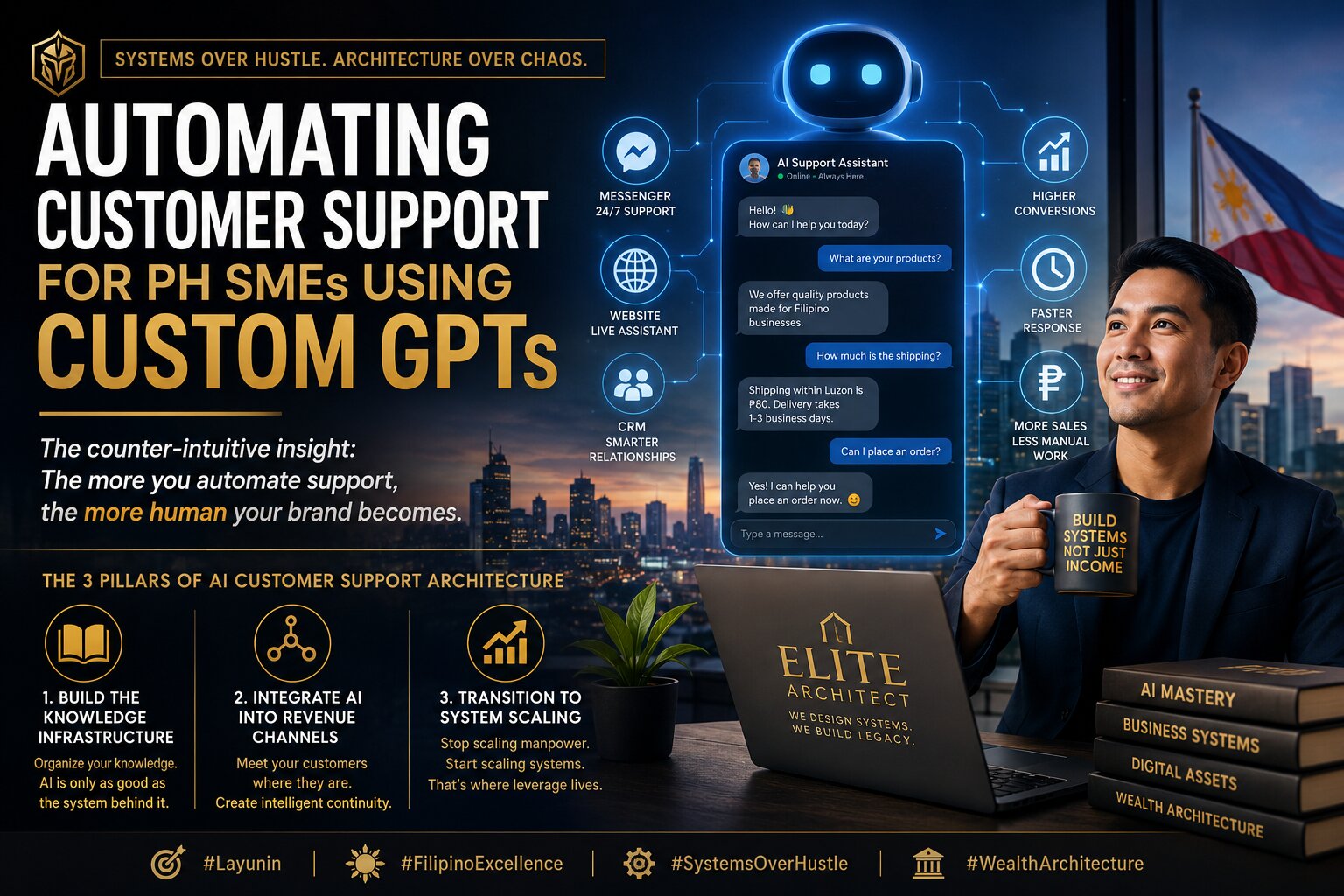
Strategic Overview
- The future of Philippine business will not be built by the companies that work the hardest. It will be built by the companies that design the best systems.
- Core Knowledge Assets
- Communication Assets
- Operational Assets
- High-Impact Integration Points
- Facebook Messenger
- Websites
- CRM Systems
- The Old SME Model
- The AI-Architect Model
- Phase 1 — Audit
- Phase 2 — Organize
- Phase 3 — Deploy
- Phase 4 — Optimize
- Phase 5 — Scale
The future of Philippine business will not be built by the companies that work the hardest. It will be built by the companies that design the best systems.
For decades, Filipino SMEs have operated on a familiar formula: more customers means more staff, more overtime, more stress, and more operational chaos.
But Artificial Intelligence changes the equation.
Today, a small business in Laguna, Cebu, Davao, or Metro Manila can deploy an AI-powered customer support system that operates 24/7, answers inquiries instantly, qualifies leads automatically, and scales without increasing payroll at the same rate.
This is not about replacing people.
This is about transforming customer support from a labor problem into a scalable digital asset.
The entrepreneurs who understand this shift early will dominate the next economic cycle in the Philippines.
The old model was hustle.
The new model is architecture.
The Real Problem with Traditional Customer Support
Most SMEs in the Philippines still rely on fragmented communication systems:
- Facebook Messenger managed manually
- Delayed replies on Instagram
- Missed inquiries on Viber
- Overloaded staff answering repetitive questions
- Customer complaints caused by slow response times
- Lost sales from unanswered messages
The hidden cost is massive.
A business owner believes they have a “marketing problem,” when in reality, they have a response-speed problem.
In the digital economy, speed is trust.
And trust creates revenue.
A customer who waits six hours for a reply is already talking to your competitor.
Custom GPTs solve this at the systems level.
Not temporarily.
Architecturally.
What Is a Custom GPT for SMEs?
A Custom GPT is a trained AI assistant designed specifically for your business.
Unlike generic chatbots, a Custom GPT can be trained using:
- Your products and services
- Your FAQs
- Your pricing structure
- Your policies
- Your brand voice
- Your workflows
- Your sales scripts
- Your customer service procedures
Instead of hiring additional manpower for repetitive support tasks, businesses create an intelligent digital operator that handles communication at scale.
Think of it as building a permanent AI employee that never sleeps.
The Elite Architect Framework
To implement AI customer support properly, Filipino SMEs must think in systems — not shortcuts.
Here are the 3 modular pillars.
Pillar 1 — Build the Knowledge Infrastructure
Most businesses fail with AI because they train it poorly.
AI is only as powerful as the operational knowledge behind it.
Before deploying a Custom GPT, SMEs must organize their business intelligence into structured assets.
This includes:
Core Knowledge Assets
- Frequently asked questions
- Pricing and packages
- Delivery processes
- Refund policies
- Product specifications
- Appointment systems
- Customer onboarding flows
Communication Assets
- Sales scripts
- Tone of voice guidelines
- Common objections and responses
- Brand positioning statements
Operational Assets
- SOPs
- Escalation procedures
- Lead qualification frameworks
- Booking instructions
The businesses that win in AI are not necessarily the biggest.
They are the most organized.
This is why AI rewards disciplined entrepreneurs.
The more structured your systems become, the more scalable your business becomes.
Pillar 2 — Integrate AI Into Revenue Channels
Most people use AI like a toy.
Elite operators use AI like infrastructure.
A Custom GPT becomes exponentially more powerful when connected to revenue-generating channels.
High-Impact Integration Points
Facebook Messenger
The Philippines is one of the largest Facebook markets in the world.
An AI assistant integrated into Messenger can:
- Answer inquiries instantly
- Capture leads automatically
- Recommend products
- Schedule consultations
- Filter spam and low-quality inquiries
Websites
Your website should not function like a digital brochure.
It should function like a digital salesperson.
An AI assistant on your website can:
- Guide visitors
- Increase conversions
- Reduce bounce rates
- Recommend offers
- Assist with purchasing decisions
CRM Systems
AI support becomes transformational when connected to CRMs.
This allows businesses to:
- Track customer history
- Automate follow-ups
- Personalize communication
- Improve retention
The objective is not simply automation.
The objective is intelligent continuity.
Every customer interaction should strengthen the system.
Pillar 3 — Transition from Manpower Scaling to System Scaling
This is the most important mindset shift.
Traditional businesses scale by adding labor.
Architectural businesses scale by improving systems.
That difference determines long-term profitability.
The Old SME Model
More customers →
More employees →
More payroll →
More complexity →
Lower margins
The AI-Architect Model
More customers →
Better systems →
Higher efficiency →
Stronger margins →
Scalable growth
This is how smaller companies begin competing with larger organizations.
AI compresses operational disadvantages.
A 5-person business with intelligent systems can outperform a 30-person business running manually.
That is the real disruption.
Not AI replacing workers.
But systems replacing inefficiency.
Why This Matters Specifically for the Philippines
The Philippines is entering a critical economic transition.
We are known globally for:
- Customer service talent
- English proficiency
- Digital adaptability
- Creativity
- Social communication skills
But many Filipino SMEs still operate with outdated business structures.
The next generation of Filipino entrepreneurs must evolve from:
- Reactive operations
- Manual workflows
- Founder dependency
- Constant firefighting
Toward:
- Digital systems
- AI-assisted operations
- Scalable assets
- Predictable automation
This is how we create stronger local businesses.
This is how we create more resilient communities.
This is how Filipino excellence becomes globally competitive.
Not through endless hustle.
But through intelligent architecture.
The Hidden Opportunity for Filipino Professionals
There is another opportunity emerging beneath this trend.
Businesses now need:
- AI workflow builders
- Custom GPT developers
- Automation consultants
- AI customer support architects
- Knowledge system specialists
This means Filipino freelancers, virtual assistants, developers, and agency owners can evolve into high-value AI operators.
The market is shifting from task execution to system creation.
The people who learn AI implementation today may become the digital infrastructure builders of tomorrow’s economy.
Elite Execution Checklist
Phase 1 — Audit
- List the top 100 customer questions
- Identify repetitive support tasks
- Analyze response delays
- Document operational bottlenecks
Phase 2 — Organize
- Build a centralized FAQ database
- Create SOP documentation
- Standardize customer communication
- Define brand voice guidelines
Phase 3 — Deploy
- Build a Custom GPT
- Connect Messenger and website channels
- Integrate with CRM systems
- Create escalation paths for human support
Phase 4 — Optimize
- Review AI conversations weekly
- Improve prompts continuously
- Add missing knowledge
- Track conversion improvements
Phase 5 — Scale
- Expand AI into sales
- Automate onboarding
- Build multilingual support
- Create AI-powered internal operations
Final Architecture Principle
The future belongs to entrepreneurs who build systems that continue producing value even when they are offline.
Manual labor creates income.
Digital architecture creates leverage.
And leverage creates freedom.
The Filipino entrepreneur who masters AI systems today will not simply build a business.
They will build infrastructure for the future economy.
#Layunin #EliteArchitect #FilipinoExcellence #SystemsOverHustle #WealthArchitecture


Leave a Reply