Strategic Overview
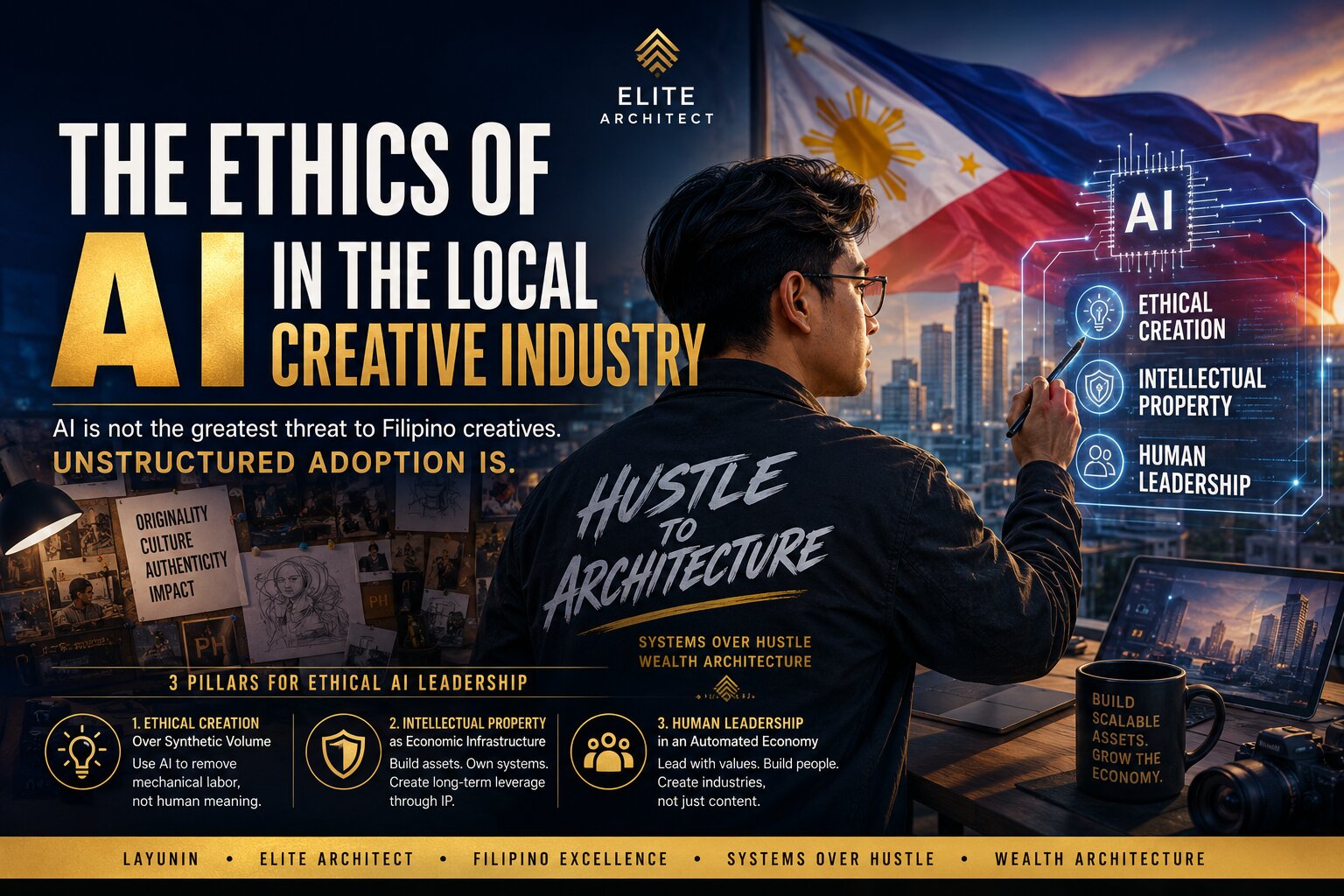
The counter-intuitive truth: AI is not the greatest threat to Filipino creatives. Unstructured adoption is.
For decades, the Philippine creative industry has operated on hustle. Designers chased deadlines. Editors survived on revisions. Writers traded time for income. Video creators competed on volume. Agencies scaled through overtime instead of infrastructure.
Now AI has entered the equation — and many creatives immediately framed it as a war between humans and machines.
That is the wrong framework.
The real battle is not Human vs AI.
It is Architects vs Operators.
The operators will use AI to produce faster content.
The architects will use AI to build scalable creative ecosystems.
And in the next decade, the architects will own the economic leverage.
The ethical challenge facing the Philippines is not whether AI should exist in the creative sector. That debate is already over. The real question is this:
Will Filipinos use AI to devalue creativity… or to multiply Filipino excellence globally?
That decision will shape the future of our economy.
The Shift From Hustle to Architecture
Most creatives currently use AI reactively:
- Faster captions
- Faster graphics
- Faster edits
- Faster revisions
- Faster outputs
But speed alone does not create wealth.
Architecture creates wealth.
Architecture means:
- systems,
- intellectual property,
- repeatable frameworks,
- digital assets,
- scalable distribution,
- and ethical leverage.
The creators who survive AI will not merely create content.
They will design systems where:
- AI handles repetition,
- humans provide taste,
- culture provides differentiation,
- and strategy creates economic scale.
This is where ethics becomes critical.
Because AI amplifies intent.
Used irresponsibly, it creates plagiarism, misinformation, creative theft, and cultural dilution.
Used strategically, it can elevate Filipino talent into a global force.
Pillar 1 — Ethical Creation Over Synthetic Volume
The first ethical responsibility is originality.
Many creators are now flooding the market with low-context AI content:
- copied visual styles,
- recycled scripts,
- cloned voices,
- derivative branding,
- and mass-produced mediocrity.
This creates short-term output but long-term erosion of trust.
The Philippine market already struggles with underpricing creative work. AI can worsen this if creators compete only on speed.
The ethical creator must instead focus on:
- interpretation,
- localization,
- strategic thinking,
- emotional intelligence,
- and cultural nuance.
AI should enhance Filipino creativity — not replace Filipino identity.
A Filipino designer who understands:
- local humor,
- regional language,
- barangay-level culture,
- OFW family psychology,
- religious sensitivity,
- and community behavior
will always outperform generic AI-generated content.
Because authenticity is now the premium asset.
Ethical Principle:
Use AI to remove mechanical labor, not human meaning.
Pillar 2 — Intellectual Property as Economic Infrastructure
The second ethical issue is ownership.
Many Filipino businesses still do not understand:
- who owns AI-generated work,
- how training data affects copyright,
- how AI models borrow patterns,
- and how digital assets create long-term leverage.
This creates dangerous vulnerability.
The future creative economy will reward people who own:
- brand systems,
- audience ecosystems,
- educational frameworks,
- proprietary prompts,
- content architectures,
- community trust,
- and distribution channels.
Not merely those who produce outputs.
This is why elite creatives must evolve into intellectual property architects.
Instead of selling:
- logos,
- posts,
- or isolated projects,
they must build:
- brand ecosystems,
- licensing structures,
- educational assets,
- AI-assisted workflows,
- and scalable creative frameworks.
The ethical Filipino entrepreneur must ask:
“Am I building disposable outputs… or durable digital infrastructure?”
Because scalable wealth is built through ownership.
Not endless client revisions.
Pillar 3 — Human Leadership in an Automated Economy
The third ethical pillar is leadership.
AI can automate execution.
It cannot automate conviction.
As automation expands, human leadership becomes more valuable — not less.
The local creative industry needs leaders who can:
- define standards,
- protect creative dignity,
- train ethical AI usage,
- mentor younger creators,
- and build industries instead of trends.
This matters deeply in the Philippines because our greatest economic advantage is not cheap labor.
It is adaptable human talent.
Filipinos are globally respected for:
- creativity,
- empathy,
- communication,
- resilience,
- and collaborative thinking.
AI should amplify these strengths.
Not erase them.
The next generation of Filipino creative leaders must therefore become:
- system builders,
- educators,
- community architects,
- and economic multipliers.
Because the goal is larger than personal income.
The mission is national capability.
The New Creative Hierarchy
The old hierarchy rewarded:
- Speed
- Technical skill
- Labor hours
The new hierarchy rewards:
- Strategic thinking
- Systems design
- Brand ownership
- Audience trust
- Ethical leverage
This changes everything.
The highest-paid creative professionals in the AI era will not necessarily be:
- the best editors,
- the fastest designers,
- or the most active freelancers.
They will be the people who build:
- scalable systems,
- recognizable authority,
- repeatable frameworks,
- and trusted ecosystems.
This is the transition from:
Hustle → Architecture
Why This Matters for the Philippine Economy
The Philippines cannot compete forever through labor arbitrage.
But we can dominate through:
- creative intelligence,
- digital entrepreneurship,
- localized storytelling,
- educational products,
- niche communities,
- and AI-assisted innovation.
A nation becomes economically powerful when its people stop selling only time and begin building scalable assets.
AI accelerates this possibility.
A solo Filipino creator can now:
- launch a global brand,
- build digital products,
- automate operations,
- create educational systems,
- and scale intellectual property worldwide.
But only if ethics guides execution.
Without ethics, AI creates noise.
With ethics, AI creates national leverage.
Elite Execution Checklist
Ethical AI Implementation Framework for Filipino Creators
1. Build Human-Centered Systems
- Use AI to reduce repetitive tasks
- Preserve human storytelling and strategy
- Maintain cultural authenticity
2. Create Original Value
- Add interpretation, not just generation
- Avoid direct style imitation
- Develop proprietary creative frameworks
3. Own Intellectual Property
- Build digital assets instead of one-off work
- Create reusable systems and templates
- Document workflows and methodologies
4. Develop Authority
- Publish insights consistently
- Teach your process publicly
- Become known for thinking, not just output
5. Scale Through Architecture
- Turn services into systems
- Turn knowledge into products
- Turn workflows into infrastructure
6. Protect Long-Term Trust
- Verify AI-generated information
- Be transparent with AI-assisted work
- Prioritize quality over content volume
Final Architecture Principle
The future belongs to creators who combine:
- human wisdom,
- ethical leadership,
- Filipino cultural intelligence,
- and AI-powered systems.
The creative industry is no longer just about talent.
It is now about architecture.
And the Filipinos who learn to architect scalable value ethically will not merely survive the AI era.
They will help build the next economic chapter of the Philippines.
#Layunin #EliteArchitect #FilipinoExcellence #SystemsOverHustle #WealthArchitecture


Leave a Reply